
Magazine › Architecture
Sacred Thresholds: When Homes Embrace Worship
A Kerala hillside reveals how contemporary Indian homes can weave spiritual space into everyday living without artifice or separation.
By the Ander Baher Editorial Desk · 25 August 2026
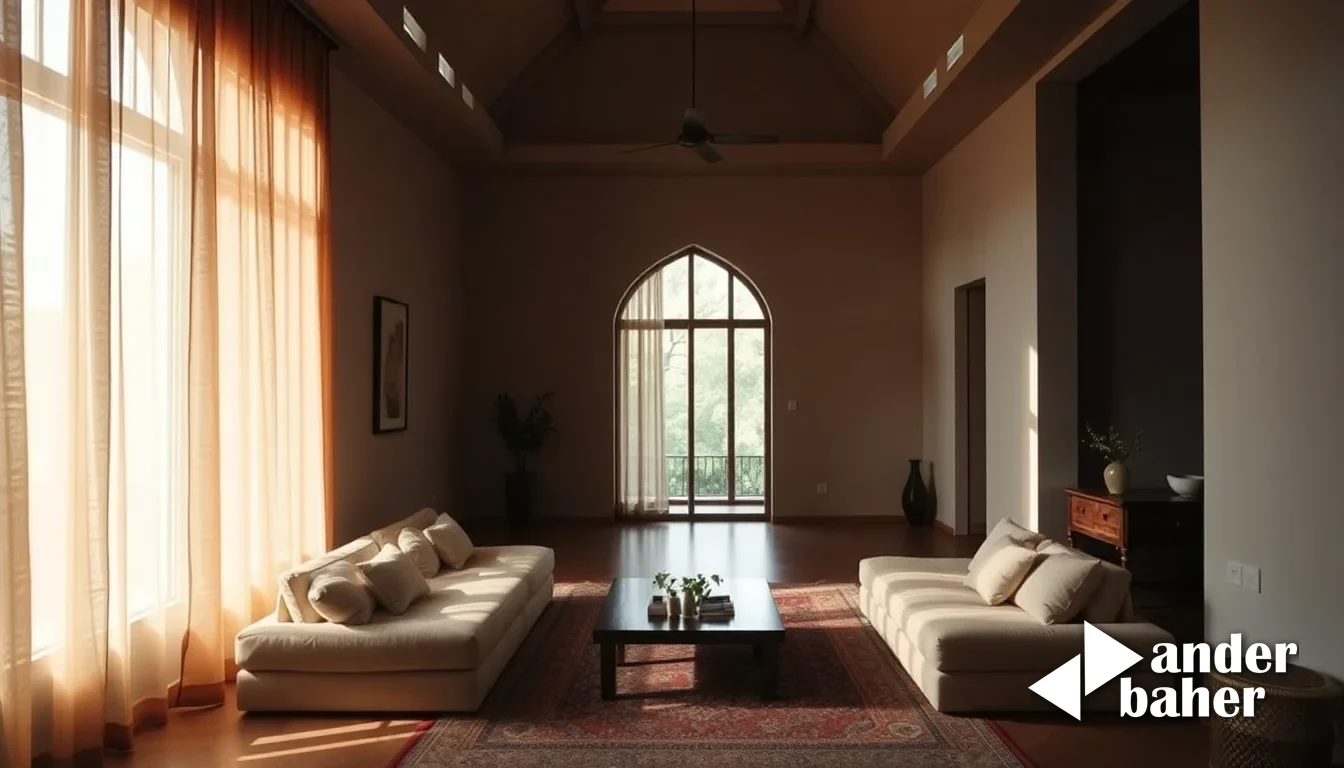
There exists a particular quietness in homes where prayer and daily life share the same air. Not the quietness of silence, but of intention—a spatial acknowledgment that the sacred and the ordinary are not opposed, but continuous. A granite farmhouse nestled into a Kerala hillside demonstrates this with uncommon clarity: beneath a solid, lived-in dwelling sits an open-air temple, neither hidden nor theatrical, but woven into the landscape as naturally as the stone itself.
This arrangement inverts our typical expectation of the home. Usually, we think of worship as something cordoned off—a room with a closed door, an altar behind a curtain, a private devotion. Here, the sacred becomes foundational. It is the earth the house rests upon, the first acknowledgment of place.
The Language of Threshold
In traditional Indian homes, the boundary between inside and outside, secular and sacred, has always been porous. A threshold marked by kolam or rangoli; a courtyard open to sky yet intimately enclosed; a verandah where morning prayers happen amid the sound of the street. Contemporary practice often abandons these gradations in pursuit of open-plan efficiency.
What this Kerala design suggests is that efficiency and spiritual acknowledgment need not be enemies. By positioning worship as integral rather than supplementary—not a corner of the living room, but the foundational gesture of the whole—the home reclaims a spatial honesty. The granite opens downward; the domestic life happens above.
Stone, Structure, and Site
Kerala's geology and climate demand a particular relationship with stone and water. Granite outcrops are not obstacles to build around, but invitations to build with. The choice to carve the temple from the existing hillside rather than impose a separate structure reflects something deeper than pragmatism: a recognition that the site has its own presence, its own spiritual language, long before the house arrives.
This matters for how we think about building in India's diverse landscapes. A Mumbai apartment dweller cannot replicate a Kerala farmhouse, nor should they attempt it. But the principle—that spiritual space emerges from genuine relationship with place, not from decoration or designated zones—translates everywhere. It asks: what does your site already hold?
Living the Contradiction
The most instructive aspect of this design is its refusal to resolve the apparent contradiction. The house above is domestic, contemporary, functional. The temple below is ancient, timeless, meditative. Rather than reconcile them through transition or visual rhetoric, they coexist vertically, each complete in itself. A family moves through both in a day, not as different people, but as whole.
For those considering their own homes—whether a renovation in Bangalore, an extension in Kerala, or a rethinking of inherited spaces in any city—the question is worth sitting with: where does spirit rest in your everyday? And can the architecture of your home acknowledge it, not as an afterthought or boutique feature, but as a genuine ordering principle?
The strongest interiors and dwellings rarely announce their intentions. They let stone speak; they let absence define presence. This farmhouse understands that restraint.
Sources & further reading
- Dezeen — Open-air temple sits beneath granite farmhouse on Kerala hillside ↗
- designboom — sordo madaleno sinks open-air art gallery four meters below ground in los cabos ↗
- Dezeen — "Light and sea breeze shape the viewing" of exhibits at open-air art gallery in Mexico ↗
- designboom — cool blue tones meet a vivid red counter inside hubarch’s new optics boutique ↗
An original Ander Baher perspective, informed by the coverage above.
Frequently asked
How can I integrate a prayer space into a modern home without sacrificing open-plan living?
Rather than cordoning worship into a corner, position it as foundational to your home's spatial logic—whether through a dedicated threshold, a courtyard gesture, or an architectural gesture that acknowledges the site itself. The principle is genuine relationship with place, not decoration.
What's the difference between a designated prayer room and a spiritually integrated home?
A designated room treats worship as supplementary; an integrated approach makes spiritual acknowledgment structural. This might mean a verandah open to morning light, a threshold marked by materiality, or—as in the Kerala example—worship as the foundational layer the home rests upon.
Can this approach work in apartments or urban homes, or is it only for rural Kerala farmhouses?
The principle translates everywhere: spiritual space emerges from genuine relationship with your specific site and daily rhythm, not from replicating one aesthetic. A Mumbai apartment or Bangalore renovation can honour this through thoughtful thresholds, materials, and spatial hierarchy suited to its own context.
Ready to transform your space — inside or out?
Tell us a little about your home or office. We'll get back within one working day.
Book a consultation