
Magazine › Balcony
The Murmur of Water: Fountains That Transform Delhi Balconies
A fountain on your balcony is not decoration—it's a deliberate act of bringing stillness into the chaos of urban living.
By the Ander Baher Editorial Desk · 24 July 2026
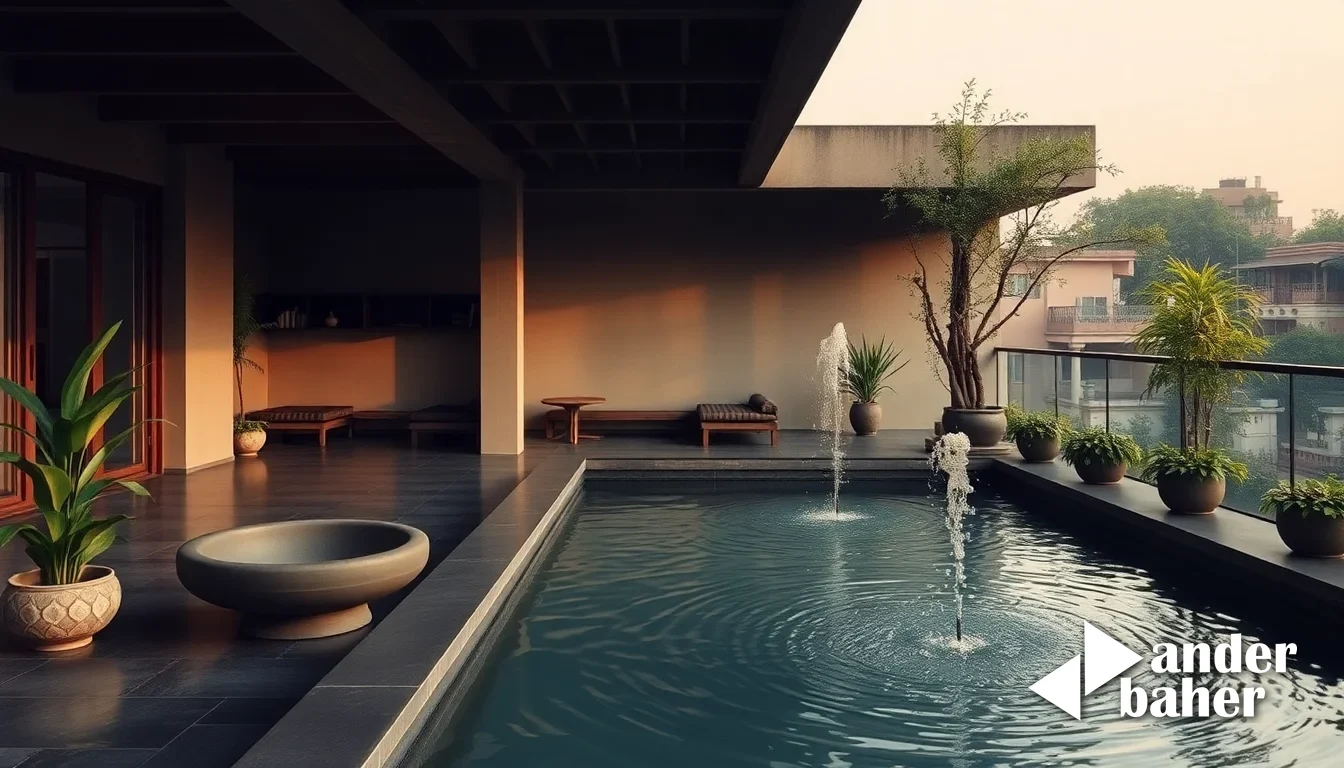
The sound arrives before the sight. Water falling in a contained rhythm becomes the ambient score of your morning coffee, your evening wind-down. A fountain on your balcony is perhaps the most underrated investment in how a home feels—not how it looks, though that matters too, but how it changes the texture of daily life in three square meters of outdoor space.
In cities like Bangalore and Delhi, where balconies are often the only contact with openness, a fountain serves a purpose far beyond aesthetics. The water cools the immediate microclimate by 2-3 degrees on hot afternoons. The sound masks traffic noise. The movement catches light and draws the eye away from neighboring buildings. These are not sentimental benefits. They are architectural interventions achieved through what appears to be simple ornamentation.
Choosing What Suits Your Space
Not all fountains belong on all balconies. A ground-level courtyard in a Mumbai heritage home might accommodate a tiered stone fountain—heavy, permanent, architectural. But a high-rise balcony in Bangalore demands restraint. Here, a self-contained fountain sitting in a corner works better: compact, contained, able to be moved if needed. Copper, ceramic, or molded stone are materials that weather well in Indian humidity without requiring constant maintenance.
The scale matters acutely. An oversized fountain crowds a 200-square-foot space and creates noise rather than ambiance. A modest fountain—perhaps 60-90 centimeters tall—becomes a focal point without dominating. In smaller balconies, consider wall-mounted cascades that drape water down a prepared surface, or basins at knee height where the sound sits close and intimate rather than projecting outward.
Practical Realities
Water features require honesty about maintenance. A fountain needs regular cleaning to prevent algae and mosquito breeding. In Indian cities with hard water, mineral deposits accumulate quickly. Monthly cleaning is not optional. Some residents prefer treating their fountain as seasonal—switched on during October through February, when weather permits longer balcony time, and drained during summer months. Others integrate them into daily routines without resentment.
Drainage is non-negotiable. Water splashes, evaporates, overflows in rain. Your balcony must slope away from the building, or a small channel directs excess water to an existing drainage point. Speak with your building's structural engineer before installation if you're uncertain.
Electricity matters too. The pump requires a weatherproof outlet, ideally on the same circuit as a bathroom or kitchen GFCI outlet to prevent short circuits during monsoon season.
The Quiet Revolution
There is something quietly revolutionary about choosing water over screens. A fountain on your balcony suggests that you have time for stillness, that you value the quality of silence, that you understand your home as a sensory retreat rather than merely a place to sleep. In the densest urban environments, this becomes almost radical.
The fountain doesn't need to be expensive or elaborate. Its power lies in consistency—the daily reminder that movement and sound and reflection are available within arm's reach, without leaving home.
Frequently asked
How much do balcony fountains actually cool the surrounding air?
A well-placed fountain can lower the immediate microclimate by 2–3 degrees on hot afternoons through evaporative cooling—a measurable benefit in high-rise spaces where direct shade is limited.
What's the honest maintenance commitment for a balcony water feature?
Monthly cleaning is essential to prevent algae and mosquito breeding, especially in Indian humidity. Hard water deposits accumulate quickly; some residents embrace seasonal operation (October–February), while others integrate daily upkeep into their routine.
Can a fountain work on a small, high-rise balcony without overwhelming the space?
Yes—a modest 60–90 centimeter self-contained fountain in a corner, or a wall-mounted cascade, provides ambiance without crowding. Scale is critical; undersizing beats oversizing on compact balconies.

Ready to transform your space — inside or out?
Tell us a little about your home or office. We'll get back within one working day.
Book a consultation