
Magazine › Architecture
When Walls Speak: Curves and Light in the Indian Home
Modern architecture's obsession with the straight line has left Indian homes colder than they need to be. What if we learned to curve?
By the Ander Baher Editorial Desk · 6 October 2026
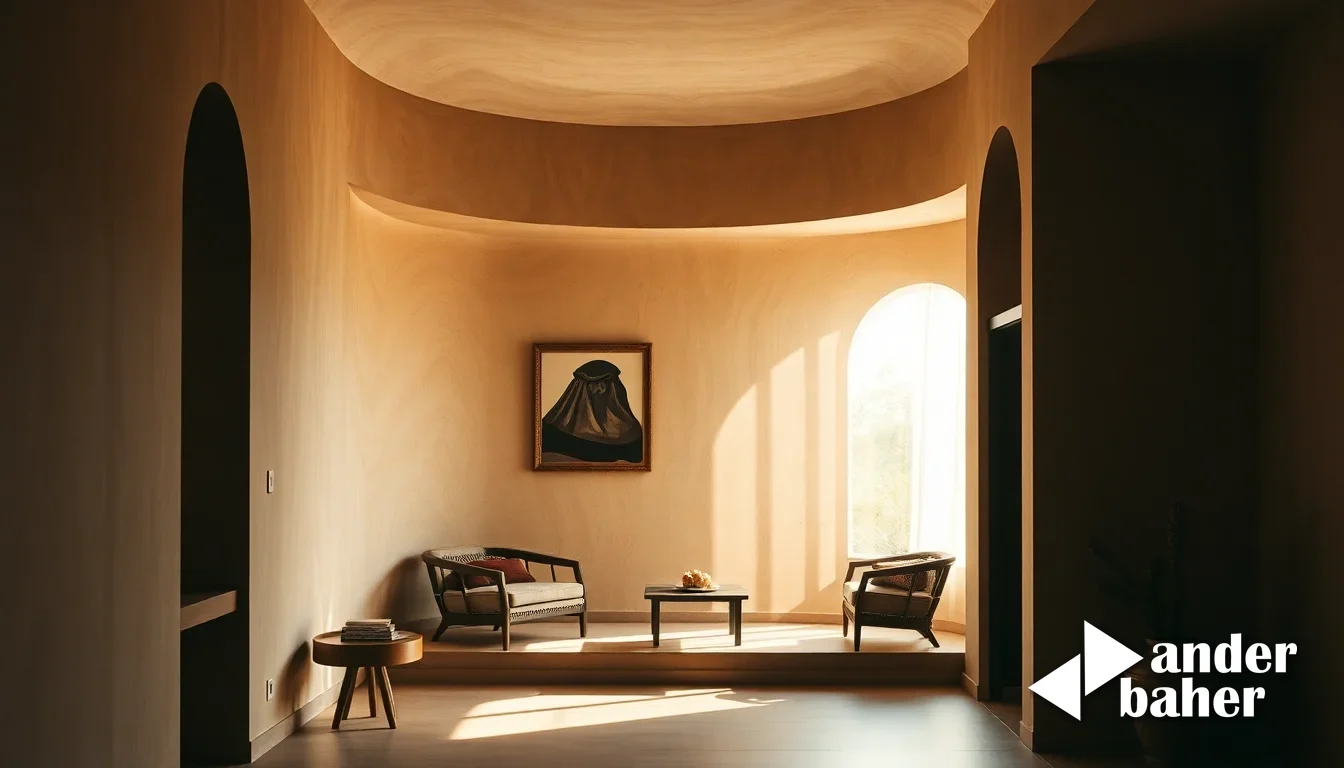
There is a moment when a room stops being functional and becomes devotional. It happens when light finds a wall at an unexpected angle, or when a curve draws your eye toward something you hadn't noticed before. For decades, Indian architects inherited a modernist vocabulary built on grids and right angles—efficient, rational, masculine. We built homes that worked like machines. What we forgot was that homes are meant to feel.
The Grammar of Curves
Le Corbusier's later work, particularly his chapel designs, revealed something his earlier manifestos could not admit: that the human eye and spirit do not live by proportion alone. Curves create pockets of intimacy. They redirect light differently. They make a room breathe rather than hold its breath. In Bangalore's growing design circles, a quieter conversation is emerging—one that questions whether India's rush toward glass towers and open-plan living has erased something essential about how we inhabit space.
Consider the traditional haveli courtyard or the curved arches of colonial Bombay—these were not accidents of ornamentation. They were responses to climate, to the quality of afternoon heat, to how shadow falls at different hours. A straight wall receives sunlight uniformly; a curved one creates gradations, pools of cool, places where the eye can rest.
Rethinking the Interior
Today's Indian homeowner—whether in Mumbai's compact apartments or Bangalore's new-build suburbs—is caught between two languages. One says: maximize square footage, minimize waste. The other whispers: slow down; notice how light moves through your bedroom at dawn.
A curved wall in an entry passage doesn't waste floor area; it changes the experience of arrival. An undulating ceiling in a living room doesn't cost more to build, but it transforms how sound travels, how people gather, how a space feels inhabited rather than merely occupied. These are not luxuries. They are corrections.
The lesson from modernism's most beautiful outliers—the ones that broke their own rules—is that constraint and rigor need not produce coldness. A curve can be as disciplined as a grid. The difference is what it gives back to the person living within it.
Small Gestures, Large Effect
Not every Indian home can be redesigned. But the next time you commission an interior or plan a renovation, ask your architect: where can we introduce a curve? Where does light need to be complicated rather than simplified? The answer might be a gentle arc in a kitchen nook, a softened corner in a bedroom, or a ceiling that rises and falls like breathing.
Architecture that only speaks the language of efficiency leaves us linguistically poor. The homes that endure—that people return to not because they own them but because they love them—are the ones that learned to say more than one thing. They learned to curve.
Sources & further reading
- designboom — on le corbusier’s 139th birthday, why ronchamp chapel still challenges modern architecture ↗
- designboom — designboom listens: andreas angelidakis’ music for making, remembering and escaping ↗
- Dezeen — Spirit of Iberian taverns informs wood-heavy Parisian restaurant ↗
- Dezeen — Bar Shrimp uses laser-etched acoustic panels to balance music and conversation ↗
An original Ander Baher perspective, informed by the coverage above.
Frequently asked
How can curved walls improve a small apartment in Bangalore or Mumbai?
A curved wall in an entry or corner redirects light, creates visual interest, and psychologically expands the sense of space without reducing usable floor area. The effect is particularly pronounced in bedrooms and living rooms where light quality changes throughout the day.
Are curved architectural elements more expensive than conventional right-angled design?
Not necessarily. A curved ceiling or softened corner often costs no more than standard construction but delivers disproportionate effect—better light diffusion, improved acoustics, and a sense of space feeling inhabited rather than merely functional.
How does curve-based design respond to India's climate?
Traditional Indian architecture—from haveli courtyards to colonial arches—used curves to manage heat and shadow. A curved wall creates gradations of light and cool pockets, whereas straight walls receive uniform sunlight. This principle remains relevant in contemporary home design.
Ready to transform your space — inside or out?
Tell us a little about your home or office. We'll get back within one working day.
Book a consultation