
Magazine › Architecture
The Vault Above: Sculpting Light and Community in Indian Homes
How sculptural ceiling geometries—inspired by civic architecture—transform private homes into spaces of contemplation and collective grace.
By the Ander Baher Editorial Desk · 17 October 2026
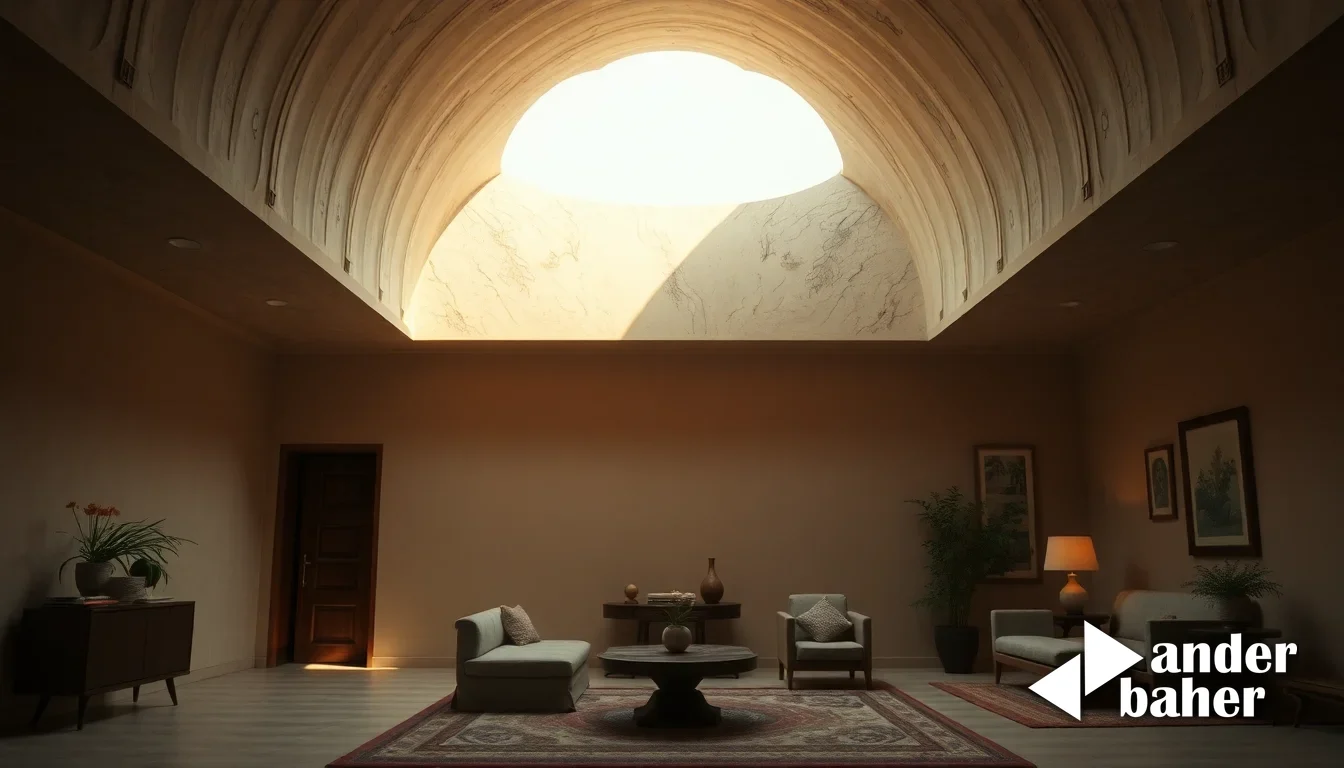
There is a particular moment—late afternoon, when the sun crosses a certain angle—when a simple room becomes a cathedral. Not through religious symbol, but through the patient geometry of its ceiling. A barrel vault does this. It curves. It rises. It catches light as the day moves, and in doing so, it transforms how we inhabit a space.
In the high-rise apartments of Bengaluru's Whitefield and the restored heritage flats of Mumbai's Lower Parel, most ceilings remain flat grids—efficient, forgettable, climate-controlled boxes. But there is another language emerging among thoughtful homeowners: one that borrows from civic and institutional architecture, not to intimidate or impress, but to deepen the texture of everyday life. The barrel vault—that continuous, half-cylindrical curve—is one of the oldest structural forms. Today, it speaks to something very contemporary: a hunger for spatial drama that feels earned, not imposed.
Why Curves Matter in the Indian Context
The Indian home has traditionally favored orthogonal rooms. Columns, walls, right angles. It is a language of clarity and separation: the kitchen is the kitchen; the bedroom, the bedroom. But in newly-handed-over towers across Sarjapura Road and in renovated period properties in Bandra East, a different sensibility is taking root. Owners are asking: What if the ceiling itself becomes a gesturing element—not merely a soffit to hide MEP, but a sculptural surface that frames time and light?
A barrel vault does this with restraint. It is not a dome, which demands a central point and can feel theatrical. It is not a flat ceiling, which is neutral to the point of invisibility. Instead, it offers a middle path: a curve that elongates a room, amplifies natural and artificial light, and creates a subtle psychological lift. In the brutal summers of Electronic City or the monsoon-battered balconies of Worli, this matters. A curved ceiling surface diffuses direct heat and glare differently than a flat plane; it allows light to travel more gently across a wall.
The Threshold Between Private and Collective Space
The most compelling use of vault geometry in Indian homes emerges at thresholds: the entry hall, the living-to-dining transition, the passage between a master bedroom and its attached spa. These are the moments where a home must express something beyond function. They are the architecture of ritual and pause.
In a just-completed high-rise off Kudlu Gate or in a refurbished flat in Pali Hill, a barrel vault spanning the entry creates an immediate sense of arrival. You are no longer in a corridor. You are in a volume. The curve acknowledges you; it makes the passage a destination, not a thoroughfare. When paired with controlled clerestory light—a narrow band of glazing along the vault's springing line—the effect is almost liturgical. Shadow and illumination dance across the plaster or exposed brick, marking the hours.
Material Honesty and the Monastic Impulse
A vault demands honest materials. Plaster, concrete, hand-formed brick, timber—surfaces that age and develop patina. The geometric purity of the curve cannot be disguised by vinyl or laminate; the form is the ornament. This aligns with a quiet movement in Indian interior design, especially among owners of newly-possessed homes in developments like Sattva City or Assetz Sublime, who are rejecting builder finishes in favor of raw, intentional materials.
The barrel vault becomes a container for this restraint. It frames a room without needing color or texture to announce itself. A simple plaster finish, left unpainted or finished in a warm ochre, breathes as the light changes. Furniture plays second fiddle. The architecture becomes the conversation.
For the renovation client—wrestling with outdated false ceilings, water-stained plaster, and the acoustic confusion of open plans—a vault reimagines the third wall. It gives structure to shapeless spaces. It reintroduces proportion.
Practical Choreography: Light, Air, Acoustics
A barrel vault is not sentimentality. It has working intelligence. The curve naturally stratifies air; warm air rises and collects at the apex, which can be managed through high-level vents or carefully positioned HVAC returns. In tropical climates—the humid reaches of Bengaluru's Sarjapura or the salt-laden air of Bandra—this thermal performance is tangible.
Acoustically, the curve softens hard-edged reverb that plagues rectangular rooms. Sound is dispersed rather than bounced. A living room vaulted over 4.5 meters absorbs speech and music more generously than a 2.7-meter flat ceiling, creating a more intimate acoustic envelope even in a 3,500-square-foot penthouse.
Lighting becomes choreography. A single flush-mounted linear fixture along the vault's spine reads as a glowing seam. Uplighting hidden at the springing line washes the curve in evening warmth. Clerestory glazing brings morning east light or evening west light in a slow, patient way—not the harsh direct sun through floor-to-ceiling glass that demands heavy thermal blinds.
The Community Question
What is remarkable about vaulted ceilings in civic spaces is their implicit offer: You are welcomed here. This volume is generous, and it has been made for gathering. That same psychology translates to the private home. A barrel-vaulted living room in a Powai apartment or a Delhi Ridge-facing bungalow stops feeling like a room and starts feeling like an occasion. Dinner conversations gain depth. Reading happens more deliberately. Even solitude feels less isolated—there is a gentle containment, a sense of being held by geometry.
This is the architecture of slowness: the opposite of the efficiency-optimized apartment. It asks the resident to stay aware of their surroundings, to notice how light arrives and departs, to understand a room across hours and seasons.
The barrel vault is not a trend to adopt thoughtlessly. It demands intention in design, honesty in craft, and a client willing to let form and light do the speaking. But for homes seeking a deeper register—whether newly-handed-over towers on Whitefield's tech corridors or period properties in the heritage lanes of Prabhadevi—it offers something rare: a ceiling that remembers the sacred scale of old civic buildings and brings it home. Explore our integrated interior and architectural practice, where such spatial conversations begin, or browse our delivered spaces to see how we've shaped light and volume for clients across Bengaluru and Mumbai.
Sources & further reading
- Dezeen — Spaces by Manah signposts Chennai community centre with barrel-vaulted roof ↗
- designboom — concert design, art spaces, and the mechanics of audience with DuckUnit ↗
- Dezeen — "Radically simple" Resonance pavilion takes centre stage at Tallinn Architecture Biennale ↗
- Colossal — Ann Toebbe’s Skewed Paintings Transform Architectural Spaces into Cherished Places ↗
An original Ander Baher perspective, informed by the coverage above.
Frequently asked
Is a barrel vault practical for a flat with a standard 2.7-meter floor-to-floor height?
Yes, though selectively. A partial vault over an entry or a single zone—rather than an entire floor—can work within standard heights. The curve's visual lift often compensates for modest physical elevation. We assess each space's proportions before recommending.
How does a vaulted ceiling perform in a Mumbai monsoon or Bengaluru heat?
When designed with clerestory ventilation and proper thermal mass (concrete or brick), a vault stratifies air effectively and reduces solar gain compared to a flat ceiling with glazing. The curve also distributes thermal stress more evenly, reducing risk of cracking in expansion-contraction cycles.
Does a barrel vault require custom construction, or can it be retrofitted into an existing apartment?
New construction is simpler, but thoughtful retrofits are possible in high-ceilinged spaces—particularly older buildings or recently-possessed towers with structural flexibility. Structural assessment is essential; it's not a cosmetic intervention but a spatial reimagining.
Ready to transform your space — inside or out?
Tell us a little about your home or office. We'll get back within one working day.
Book a consultation